
Read the details of Medical Tourism opportunities available under the category of Hair Transplant Procedure
 Amritsar city is located in the northwestern state of Punjab in India. Founded in the 16th century, the historical name was Rāmdāspur and colloquially called as Ambarsar. Inextricably associated with Sikhism from the very beginning of its foundation, Amritsar is amongst the most venerated places of the world. At the center of the city is the gilded Golden Temple (Harmandir Sahib), the holiest Gurudwara (Sikh religious complex). The city name is a derivative from Amrit Sarovar (pool of nectar) amidst which stands the Golden Temple. The soulful sound of spiritual prayers from Gurudwaras makes the beginning of the day very divine and peaceful. The Gobindgarh Fort and Ram Bagh built by Maharaja Ranjit Singh, the founder of the Sikh Empire are also here. Amritsar portrays the gallant character of Punjab. Jallianwala Bagh is a witness of the most evocative monument to India’s freedom struggle. Amritsar has also held the address of some of the oldest markets like Guru Ka Bazaar. The city is also a center of the blooming industry of textiles, particularly shawls, carpets, and woolen products.

Golden temple is a Gurudwara (religious complex) which is a most secret shrine to Sikhism. Erected on a platform in the mid of a big reservoir called Amrit Sarovar (pool of nectar), where pilgrims bathe. Guru Arjan Dev initiated the construction of the Golden Temple. Accounts suggest that Guru Amardas purchased the land from Emperor Akbar and decided to build a reservoir at the site. After his death, work was completed by Guru Ramdas and also came to be known as Chak Ramdas or Guru Ka Chak. Holiest of Sikh shrines, the Golden Temple is a major pilgrimage destination and popular tourist attraction for people from around the world.
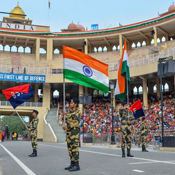
This is the last point at the border between India and Pakistan, which more or less 30 km from Amritsar. Located on the historic Grand Trunk Road (now NH-1), once connected to Lahore. Attari Border is the main
access point overland between India and neighboring countries. A flag-lowering ceremony called the Beating Retreat border ceremony held daily during sunset by both sides. Along with the interactive patriotic fiesta that precedes it, the ceremony is an immense fascination for visitors from all edges of the world.
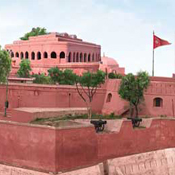
Famously known as the "Bhagian da Qilla" (fort of the Bhangis) founded in the 18th century by Bhangi Misl . In the 18th century, The Punjab region (including the territory which is now in Pakistan) was administered by clans called Misls. In the 1760s a local chieftain Gujar Singh Bhangi built this as a mud fortress, and it came to be known as “Bhagian da Qilla.” They owned the fort for almost 49 years. In the year 1809, Gobindgarh was vanquished and enhanced in the early 19th century by Sandhawalia Jat. Maharaja Ranjit Singh renamed it after the 10th Sikh guru, Guru Gobind Singh. Later the fort was renovated with help of a French architect. The fort is guarded by five canons which included the famous two ‘Zamzama' cannon. Today the fort is being developed as a unique live museum, as a repository of Punjab’s history.

Jallianwala Bagh is a martyr’s memorial built to mark to sacrifice of the thousands of men and women at this spot during the freedom struggle. This place is a walled Bagh or garden near the Golden Temple in Amritsar. On 13 April 1919, around 2000 men, women, and children had gathered to protest against British rule. A British soldier’s troop drove by Brigadier-General Reginald Dyer opened fire at the crowd, relentlessly massacring the protesters. Some people dispersed in panic, jumping into a well in affording to escape the gunfire, died. Martyrs’ Memorial built in the shape of an eternal flame, a section of the wall having bullets marks, also the well, has been protected as a reminder of the unfortunate incident.